
 The day began early. We are doing pretty well adjusting to the time difference, but are waking up early. Alan went back down to the beach to catch the sunrise since it had been cloudy the day before. This time was a success with a beautiful sunrise.
We gathered our cameras, etc. and headed to breakfast and a 7:40 a.m. pick up by the Daintree Discovery Tour folks. GoNext, the travel agency we came with, had a Daintree rain forest tour, but Alan wanted to see what other tours might be available. We looked at several brochures and settled on the Daintree Discovery Tour. It was a great decision.
 We toured with Cam, our guide, Steph & Nick, newlyweds from Melbourne, a couple from Great Britain and two men from Dallas for a total of nine. Cam, our guide and a naturalist by profession, had a wealth of knowledge about the history of the area, the rain forest and its plants and animals. The Daintree rain forest is the oldest, continually sustained rain forest in the world. It is especially noteworthy since it directly connects to the Great Barrier Reef, like the Daintree, a World Heritage site.
We toured with Cam, our guide, Steph & Nick, newlyweds from Melbourne, a couple from Great Britain and two men from Dallas for a total of nine. Cam, our guide and a naturalist by profession, had a wealth of knowledge about the history of the area, the rain forest and its plants and animals. The Daintree rain forest is the oldest, continually sustained rain forest in the world. It is especially noteworthy since it directly connects to the Great Barrier Reef, like the Daintree, a World Heritage site. 
- root structure for moist, soft ground,
- how large ferns grow near the tops of trees, collecting falling leaves and water for nourishment.

 We came across a 6- or 7-inch spider (including legs) near our walkway. We stopped to watch her eat a fly that Cam caught and had been bugging us (she became our hero then!). After the fly was subdued, we watched her spin more of her web to repair the damage made by the fly.

We also saw a couple of small lizards and an Australian bushturkey who was busy crafting her nest out of fallen leaves into a sizable pile. The bushturkey is about 30 inches tall, and though it resembles the North American turkey, it is a very different species. People thought that one of the lizards was actually a snake, hanging around and plotting how to get either a turkey dinner or at least some scrambled eggs, but after looking at the pictures, it was clear that our "snake" had legs!"
Twice during the day, we crossed the Daintree River by ferry. The height of
the river varies greatly due to both the ocean tides and the level of rainfall, so building a bridge isn't an especially feasible option. Boarding a ferry is the most efficient way of crossing.

Our next stop was the Alexander Lookout for a panoramic view of the Daintree river as it empties into the ocean. The rain forest is a vital part of the sustainability of the coral reef. From the lookout we saw Snake Island and Low Isles, which we had seen from the catamaran on our way to the reef.
From Alexander Lookout it was on to Cape Tribulation. Captain Cook named Cape Tribulation, acknowledging the difficulty he had navigating in the area of the Great Barrier Reef. Of course, this was uncharted waters for westerners, and the coral reef is very near the surface throughout this area, which covers space the size of Great Britain. His ship ran aground close to this Cape.

 There is an absolutely beautiful cove where the rain forest meets the sea. It was sunny and the water was very blue. We walked the beach and then through the rain forest to a lookout for great view of both water and mountains. Cam gave us about half an hour to explore the area on our own. We even took flat Pete to view the water and get his picture taken.
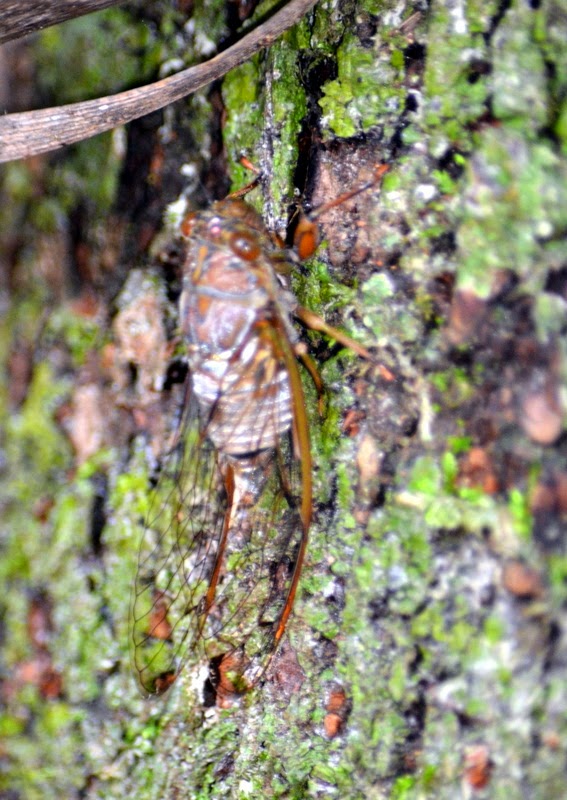
 When we gathered at the van, Cam took us on a short walk to look at interesting insects he found. Each had selected a place to "hide in plain sight" by choosing a place that matched it's coloring.
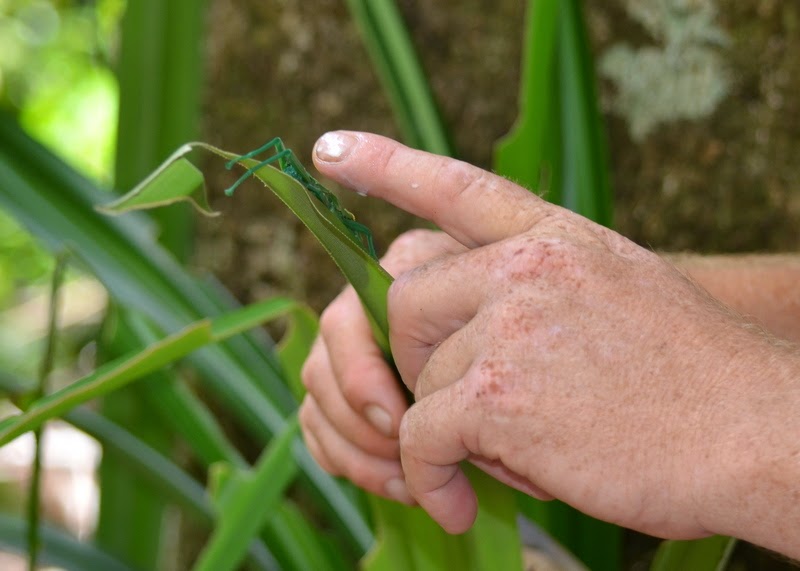
The most interesting was the peppermint stick insect. It was long and green and was resting on a leaf that looked like a larger version of a blade of grass. It was hard to spot unless you looked at the leaf from underneath so the insect's shadow was visible. When touched, the peppermint stick insect sprayed a white substance that smells like peppermint.
There is an absolutely beautiful cove where the rain forest meets the sea. It was sunny and the water was very blue. We walked the beach and then through the rain forest to a lookout for great view of both water and mountains. Cam gave us about half an hour to explore the area on our own. We even took flat Pete to view the water and get his picture taken. When we gathered at the van, Cam took us on a short walk to look at interesting insects he found. Each had selected a place to "hide in plain sight" by choosing a place that matched it's coloring. The most interesting was the peppermint stick insect. It was long and green and was resting on a leaf that looked like a larger version of a blade of grass. It was hard to spot unless you looked at the leaf from underneath so the insect's shadow was visible. When touched, the peppermint stick insect sprayed a white substance that smells like peppermint.
 We had lunch in a rain forest clearing in a private park, under a shelter-like structure. We explored along a clear, babbling stream bank with large fish coming to greet us while Cam set out our lunch. It was sort of a boxed lunch with a large multi-grain roll, meat, and salads, all very tasty. We sat across from our newly-wed friends and talked about their life in Melbourne and their wedding on the past week-end. We also learned about Vegemite and had a chance to sample it.
 After eating and packing up, we headed to the Daintree Ice Cream Company for dessert. They grow fruit for their ice cream we had never heard of, but it was delicious. The flavors change each day. Cam had encouraged us to try it even if it didn't sound good. We all chose the 4 flavor sampler that had macadamia, banana, black sapote, and wattleseed. One of them tasted like chocolate, and another like hazelnut. He was pleased to collect eight empty containers as we all liked it. Apparently sometimes the flavors don't go over well with the guests!
 After ice cream, we drove back a private drive to a 4-wheel drive vehicle that had definitely seen better days. Seven of us climbed on the bench seats in back with Cam and one of the men in front. We were headed to Cassowary Falls located on a private cattle station. After bumping along a dirt trail and driving through two small creeks, we arrived at the falls.
 The water dropped a couple hundred feet creating a small pool of water. As we walked up we saw a water dragon sunning on a rock and several turtles sunning themselves on a fallen rock across the pond. Cam assured us the pool was crocodile-free and five of our group and Cam went swimming. Alan and Joyce preferred to watch from dry land while sitting on the rocks. It was a gorgeous, peaceful place.
 After the swim, Cam brought out fish and turtle food and began feeding them. The turtles came from across the pond, and fish jumped to grab the food. One would have never guess there were so many fish swimming in and around our group! The people that were in the water were even more shocked. There was even a sizable eel that joined in the frenzy.
Speaking of cassowary, this was prime country to see a cassowary. This is a large bird, much like an ostrich or emu, but is native to this part of the world, and apparently is 'prettier'. The birds are about 5 to 6 feet tall and have a cushioned helmet that protects their head. We didn't get to see one, but we saw numerous signs warning us that they could be crossing the road. Like many animals we've seen, the female lays the eggs, but the male is responsible for raising the chicks. Apparently they don't do a great job, since several of the chicks are usually lost to predators, but he usually nurses at least one along to adulthood.
Our day in the rain forest ended with a hunt for a crocodile. The crocodile is the main predator in this part of the world, at least near the river. There are humans who become croc lunches occasionally, but that isn't a common occurrence. Nonetheless, we were given pretty clear warnings to keep our arms and other dangly parts inside the boat, to not cause any temptation.
We boarded a pontoon boat, that was pretty spacious for the eight of us. Our guide had spent his life on this part of the river and knew it, and it's inhabitants well. Because the air temperature was quite warm and we were late in the day, we found that most of the crocs were sleeping; some can be underwater for up to 3 hours without surfacing. As reptiles, they use their environment to maintain their body temperature. We had quite a bit of rain the previous day, and some while we were touring, so the cooler water coming down from the mountains might have been enticing them. There had been some sightings earlier in the day, but when we visited their stomping grounds, all we could see were the slide marks where they had slid into the brush or into the river.
 Our guide was quite disgusted with a couple of the local farmers who were letting their cattle down into the river, without a fence to keep them in their paddock (field). Some of the smaller ones were tempting meals for the crocodiles. We even chased a cow that was fully in the river (probably to cool off) back to shore with the boat.
 We headed downstream, and came across Barrett, a saltwater crocodile, who seemed to be in charge of this area. Each kilometer of the river or so becomes the territory of these large animals, and the locals call them by name. To be honest, Barrett was so still that we couldn't be fully convinced that he wasn't a plastic replica just to make us think that we had seen a crocodile in the wild. We floated down the river a bit further to see if there were any other interesting sightings, and when we returned, we caught Barrett with his mouth wide open in an apparent yawn. Now we were fully convinced, even though we were too slow with the cameras to convince you!
After a short rest, we took the local shuttle bus back into Port Douglas to search for supper. One of the recommended places for a moderately priced seafood dinner was a place near the marina called 'On the Inlet'. Moderately clearly means something different here, but we enjoyed a very good meal of locally caught fish in an open-air environment on the Inlet. A storm looked like it would hit us, but we were fine.
We looked at a couple of shops on the way back to pick up the shuttle, but we were pretty beat, so we headed back to the hotel pretty quickly after supper. We had an early departure for the airport in Cairns the next day, so we needed to regroup and repack for the trip to Sydney.
We looked at a couple of shops on the way back to pick up the shuttle, but we were pretty beat, so we headed back to the hotel pretty quickly after supper. We had an early departure for the airport in Cairns the next day, so we needed to regroup and repack for the trip to Sydney.


